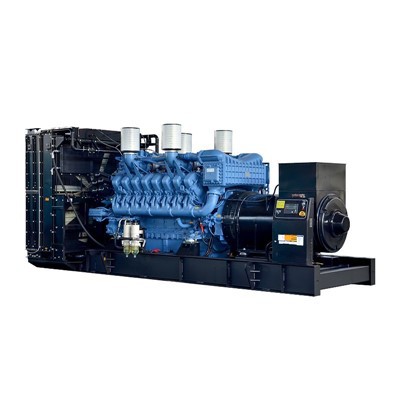
Ensuring proper ventilation for an 11kV diesel generator is crucial for its efficient operation, longevity, and the safety of the environment. As a trusted supplier of 11kv Diesel Generator, we understand the significance of ventilation in the performance of these high - power machines. In this blog, we will explore the key aspects of providing adequate ventilation for 11kV diesel generators.
Why is Ventilation Important for an 11kV Diesel Generator?
An 11kV diesel generator operates by burning diesel fuel in an internal combustion engine to produce electricity. During this process, a significant amount of heat is generated. If this heat is not dissipated properly, it can lead to a variety of problems.
Firstly, overheating can cause damage to the engine components such as pistons, cylinders, and bearings. High temperatures can also reduce the efficiency of the generator, leading to increased fuel consumption and lower power output. Moreover, the combustion process in the diesel engine produces exhaust gases, including carbon monoxide, nitrogen oxides, and particulate matter. These gases are not only harmful to the environment but also pose a serious threat to human health if they are not properly vented.
Calculating the Ventilation Requirements
The ventilation requirements for an 11kV diesel generator depend on several factors, including the generator's power rating, the ambient temperature, and the type of enclosure.
Heat Dissipation
The heat generated by the generator can be calculated based on its power output and efficiency. Most 11kV diesel generators have an efficiency of around 30 - 40%. This means that 60 - 70% of the energy from the diesel fuel is converted into heat. To calculate the heat generated (Q), we can use the following formula:
[Q=(1 - \eta) \times P]
where (\eta) is the efficiency of the generator and (P) is the power output of the generator.
For example, if we have an 11kV diesel generator with a power output of 1000 kVA and an efficiency of 35%, the heat generated would be:
[Q=(1 - 0.35)\times1000\times1000 = 650000\space W]


This heat needs to be removed from the generator room to maintain a safe operating temperature. The ventilation system should be designed to provide enough air volume to carry away this heat.
Airflow Requirements
The airflow required for ventilation can be calculated using the following formula:
[V=\frac{Q}{C_p\times\rho\times\Delta T}]
where (V) is the airflow rate ((m^3/s)), (C_p) is the specific heat capacity of air ((1005\space J/(kg\cdot K))), (\rho) is the density of air ((1.2\space kg/m^3)), and (\Delta T) is the temperature rise across the generator.
Assuming a temperature rise of 10°C, the airflow rate for the above - mentioned generator would be:
[V=\frac{650000}{1005\times1.2\times10}\approx54\space m^3/s]
Designing the Ventilation System
Inlet and Outlet Sizes
The ventilation system for an 11kV diesel generator typically consists of an inlet and an outlet. The size of the inlet and outlet should be designed to allow the required airflow. The inlet should be located at a low level to ensure that cool air is drawn into the generator room. The outlet, on the other hand, should be located at a high level to allow the hot air to escape.
The area of the inlet and outlet can be calculated based on the airflow rate and the air velocity. A typical air velocity for the inlet and outlet is around 3 - 5 m/s. Using the airflow rate calculated above ((V = 54\space m^3/s)) and an air velocity of 4 m/s, the area of the inlet and outlet would be:
[A=\frac{V}{v}=\frac{54}{4}=13.5\space m^2]
Ducting
Ducts can be used to direct the airflow in the ventilation system. When designing the ducts, it is important to minimize the pressure drop. A high pressure drop can reduce the efficiency of the ventilation system. The ducts should have smooth inner surfaces and should be as straight as possible. Elbows and bends in the ducts should be kept to a minimum, and if they are necessary, they should have a large radius.
Ventilation Fans
Ventilation fans are used to provide the required airflow. The fans should be selected based on the airflow rate and the static pressure. The static pressure is the resistance to the airflow in the ventilation system, which includes the resistance of the ducts, filters, and other components.
There are two main types of ventilation fans: axial fans and centrifugal fans. Axial fans are suitable for applications where a large volume of air needs to be moved at a low pressure, while centrifugal fans are better for applications where a high pressure is required.
Maintenance of the Ventilation System
Regular maintenance of the ventilation system is essential to ensure its proper operation. The following maintenance tasks should be carried out:
Filter Cleaning
The air filters in the ventilation system should be cleaned or replaced regularly. Dirty filters can restrict the airflow, reducing the efficiency of the ventilation system. The frequency of filter cleaning or replacement depends on the operating environment. In a dusty environment, the filters may need to be cleaned or replaced more frequently.
Fan Inspection
The ventilation fans should be inspected regularly for signs of wear and tear. The fan blades should be checked for damage, and the motor should be inspected for proper operation. Any loose or damaged parts should be repaired or replaced immediately.
Duct Inspection
The ducts should be inspected for leaks, blockages, and corrosion. Leaks in the ducts can reduce the airflow, while blockages can prevent the proper movement of air. Corrosion can weaken the ducts and lead to structural failure.
Special Considerations for Different Applications
High Voltage Diesel Generator in Industrial Settings
In industrial settings, 11kV diesel generators are often used as backup power sources. The ventilation system should be designed to handle the high heat loads generated by these generators. Additionally, the ventilation system should be able to remove any contaminants that may be present in the industrial environment, such as dust, fumes, and chemicals.
Mining Diesel Generator
In mining applications, 11kV diesel generators are used in harsh environments. The ventilation system should be designed to prevent the ingress of dust and other particles. The exhaust system should also be designed to ensure that the exhaust gases are safely removed from the mining area.
Conclusion
Proper ventilation is essential for the efficient operation and longevity of an 11kV diesel generator. By calculating the ventilation requirements accurately, designing a suitable ventilation system, and carrying out regular maintenance, you can ensure that your generator operates safely and efficiently.
If you are in the market for an 11kV diesel generator or need advice on ventilation systems for your generator, we are here to help. Our team of experts can provide you with the best solutions for your specific needs. Contact us for more information and to start a procurement discussion.
References
- "Diesel Generator Handbook" by Cummins Inc.
- "Electrical Power Generation, Transmission, and Distribution" by Theodore Wildi.