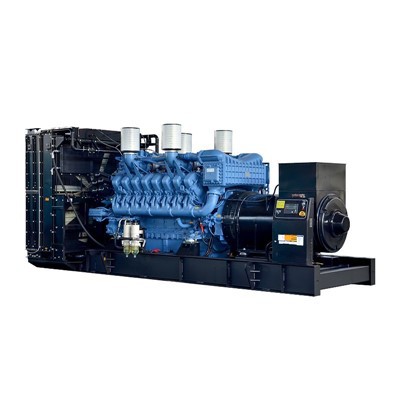
As a supplier of small diesel generator sets, I understand the importance of ensuring the optimal performance of these engines. One crucial aspect that significantly impacts the engine's efficiency and power output is the compression ratio. In this blog post, I'll share with you how to check the compression ratio of a small diesel generator set's engine, which is essential for maintaining its functionality and longevity.
Understanding the Compression Ratio
Before delving into the checking process, it's vital to understand what the compression ratio is. The compression ratio is the ratio of the volume of the combustion chamber when the piston is at the bottom of its stroke (bottom dead center - BDC) to the volume when the piston is at the top of its stroke (top dead center - TDC). A higher compression ratio generally means more efficient combustion and better performance, but it also requires higher - quality fuel and more precise engine design.
Tools Required
To check the compression ratio of a small diesel generator set's engine, you'll need the following tools:
- Compression tester: This is a specialized tool that measures the pressure inside the combustion chamber during the compression stroke.
- Feeler gauges: Used to measure the clearance between the piston and the cylinder head.
- Dial caliper: For accurate measurement of piston diameter and cylinder bore.
- Engine service manual: It provides detailed information about the engine's specifications, including the correct compression ratio.
Step - by - Step Process to Check the Compression Ratio
Step 1: Prepare the Engine
First, make sure the engine is cool. Working on a hot engine can be dangerous and may lead to inaccurate measurements. Disconnect the battery to prevent accidental starting. Remove all the spark plugs or glow plugs, depending on the type of diesel engine. This allows the engine to turn over freely and makes it easier to measure the compression.
Step 2: Measure the Cylinder Volume at BDC
Use a dial caliper to measure the bore diameter of the cylinder. The bore is the inner diameter of the cylinder. Then, measure the stroke length, which is the distance the piston travels from BDC to TDC. The volume of the cylinder at BDC can be calculated using the formula for the volume of a cylinder: (V_{BDC}=\pi\times(\frac{d}{2})^2\times h), where (d) is the bore diameter and (h) is the stroke length.
Step 3: Measure the Cylinder Volume at TDC
To measure the volume at TDC, you need to account for the clearance volume. The clearance volume is the volume remaining in the combustion chamber when the piston is at TDC. Use feeler gauges to measure the clearance between the piston and the cylinder head. Add this clearance volume to the volume of the combustion chamber itself (which can be found in the engine service manual). This gives you the volume at TDC, (V_{TDC}).


Step 4: Calculate the Compression Ratio
The compression ratio ((CR)) is calculated using the formula (CR=\frac{V_{BDC}}{V_{TDC}}). For example, if (V_{BDC} = 500) cc and (V_{TDC}= 50) cc, then the compression ratio (CR=\frac{500}{50}=10:1).
Step 5: Use a Compression Tester
Install the compression tester into one of the spark plug or glow plug holes. Have an assistant crank the engine for about 4 - 5 compression strokes. The compression tester will display the maximum pressure reached during the compression stroke. Repeat this process for each cylinder. Compare the readings with the specifications in the engine service manual. If the readings are significantly lower than the specified values, it may indicate problems such as worn piston rings, leaking valves, or a damaged head gasket.
Importance of a Correct Compression Ratio
A proper compression ratio is crucial for the efficient operation of a small diesel generator set. If the compression ratio is too low, the engine may have difficulty starting, produce less power, and consume more fuel. On the other hand, an excessively high compression ratio can lead to knocking, which can damage the engine components over time.
Common Issues and Solutions
- Low compression: If you find that the compression in one or more cylinders is low, it could be due to worn piston rings, damaged valves, or a blown head gasket. You may need to replace these components to restore the proper compression ratio.
- Uneven compression: Uneven compression between cylinders can cause rough running and reduced performance. This can be caused by uneven wear, misaligned valves, or a cracked cylinder head. A professional mechanic may need to diagnose and repair the issue.
Our Small Diesel Generator Sets
At our company, we offer a wide range of high - quality small diesel generator sets. Whether you are looking for a Diesel Generator For Camping to power your outdoor adventures or a Portable Diesel Generator Set for backup power at home, we have the right solution for you. Our 5kw Diesel Generator Set is a popular choice, known for its reliability and efficiency.
Contact Us for Purchase and Consultation
If you are interested in purchasing a small diesel generator set or have any questions about checking the compression ratio or other maintenance issues, we encourage you to contact us. Our team of experts is ready to assist you in finding the best generator for your needs and providing you with the necessary support and guidance.
References
- Automotive Engine Design, Second Edition by Richard Stone
- Diesel Engine Theory and Thermodynamics by Philip C. Rollins
- Small Engine Repair Manuals (various manufacturers)